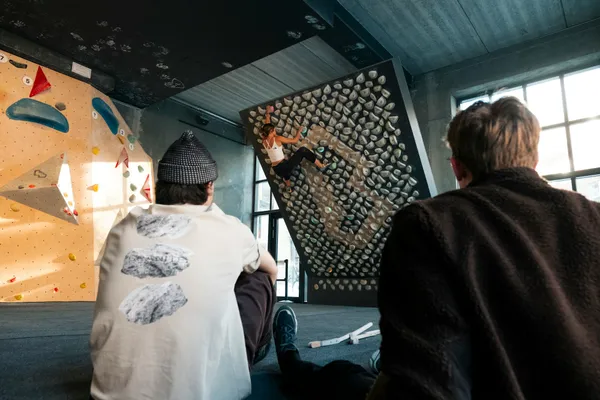
From the other side of a climbing room, the wall can appear to be an arrangement of color. The holds gather into patterns, interrupted by larger surfaces that project into the room. A person standing below one section gives the whole composition a scale. Without them, it would be easier to overlook how much distance exists between some of the shapes.
The view changes as you get closer. An outline that looked simple from across the room begins to reveal a less regular surface. One side catches the light while another falls into shadow. The color that first made a hold easy to find becomes only part of what there is to look at. Its depth has begun to matter.
A climbing hold is an interesting object to consider in this way because its appearance is so closely tied to the possibility of contact. Even while standing on the floor, people look toward the wall with their hands partly occupied in imagining it. Fingers curl, a wrist turns, or an arm is extended into an empty patch of air. The room is full of small gestures directed toward things beyond reach.
The shape from below
A sequence can look persuasive when traced with the eyes. There is a starting point, then another shape that seems to follow it, then a possible continuation farther up the wall. The imagination makes short work of the spaces between them. Once a person begins moving, those spaces acquire a different meaning. A neat visual sequence becomes a series of positions that take time to occupy.
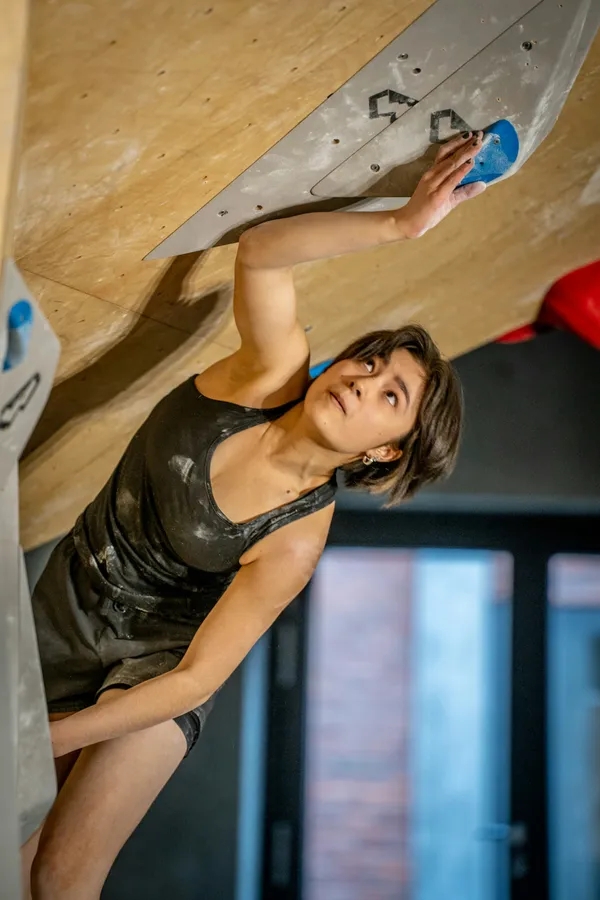
The difference is visible even to somebody who is simply watching. A hand remains in one place while the rest of the body changes around it. A foot occupies a detail that was easy to miss from below. A pause draws attention to a part of the wall that had seemed incidental. The arrangement keeps offering information that the first glance passed over.