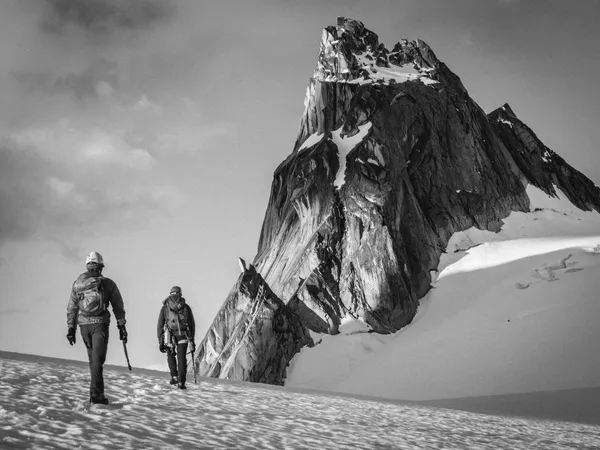
Snow occupies much of the view, while a dark ridge gives the eye a place to stop. The granite looks sharply defined against the sky and less distinct where its lower edges meet the pale ground. In a photograph, those broad shapes can seem close together. It takes a smaller detail to begin explaining the distance between them.
Where a person appears in the landscape, the scale changes. A figure that was easy to overlook becomes the part of the picture I keep returning to. I can compare the person with a patch of snow, then look up again toward the rock. The wall grows larger in my understanding while remaining exactly where it was in the frame.
This is one of the things I enjoy about photographs of an approach. Much of the outing is still ahead of the people moving through the view. The rock has yet to become a collection of close surfaces. It remains a large arrangement of light and shadow, with only some of its smaller details available from that position.
On foot, the changes of scale arrive less neatly. A section of the wall can seem almost unchanged for a long time. Another part becomes more visible as the line of the approach shifts. I try to connect what is appearing in front of me with the broader shape I noticed earlier, occasionally losing track of which dark edge I had been following.
Snow makes that exercise particularly absorbing. It simplifies some parts of the ground and draws attention toward whatever interrupts the pale surface. A rock showing through becomes distinct from the larger shapes above it. Shadows begin explaining differences that were hard to read at first. I find myself looking repeatedly between the near detail and the wall beyond.
There is also the changing position of the other people. From one view, a figure sits against a pale background and is easy to pick out. Farther along, the person briefly overlaps a darker part of the landscape. In photographs, I spend time looking for these small shifts because they affect how much of the distance remains apparent.
A close image of granite offers a very different account. The broad ridge has become a surface with edges and variations of color. It can be difficult to connect that detail with the view from the approach. Looking between the two reminds me how much the outing depends on moving through a place before any one part of it becomes familiar.
I tend to remember an approach through separate intervals: the first clear view of the wall, a moment when part of it disappears, then the point at which a detail I had been watching becomes easier to distinguish. Those intervals seldom make a complete map. They give the journey a sequence I can recall without being able to recover every step.
Later, I return to the wider photograph and look again at the space beneath the ridge. The snow occupies more of the frame than I remembered. My attention has been drawn toward the granite, leaving much of the approach available only at the edges of the view. I begin following those smaller shapes again, taking a little longer to reach the wall with my eyes.